 |
 |
 |
 |
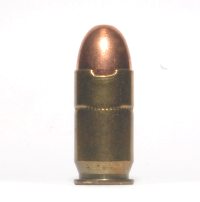 |
| Smashed primer | Deep seated bullet | Upside-down bullet | Missing
primer and a metal flap from flash hole |
Buckled case |
 |
||||
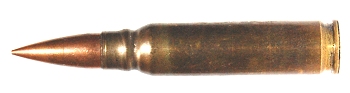
| Crumpled
neck GI Production |
||||
This section contains brief discussions of various ballistics and shooting related topics as requested by correspondents. If you have a question you have been trying to find an answer to (keep 'em ballistics and shooting related--see your minister for the mysteries of life) email me by clicking here and I'll do my best to find the answer for you and if it is of general interest, publish it here. If you can contribute additional input to one of the answers I'd would appreciate hearing from you too.
Check back frequently as new topics are always being added.
On this page:
Is factory ammunition better than
handloads?
What are the dates that the US military ammunition
stopped using corrosive primers?
What effect does lubricant in the bore have on bullet
impact?
How many spare magazines is enough for my rifle and pistol?
How long will the springs in loaded magazines last?
How much of the target does my front sight cover at a given
distance?
Do you have any suggestions for maintaining my
AR type rifle?
How can I determine the freshness of batteries I buy
for my red dot sights and flashlights?
How
can I test my batteries?
How do I determine how much to move or file my fixed sights
to get a zero?
How much ammunition for my firearms do I "need?"
How can I prepare firearms and ammunition for long term
storage?
What are the various primer types and sizes?
Do you have any plans for or parts sources for reasonably
priced gun racks?
How do you remove the
handguards on an AR rifle?
Q. Is factory ammunition better than handloads?
A. While factory produced ammunition can be very high quality, it is not necessarily the most accurate ammunition for a particular firearm. Factory ammunition is made to give performance within the stated SAAMI specifications for most firearms, but by necessity can not be optimized for every barrel and firearm. The SAAMI standards are quite generous; ± 90 fs on velociy. Some folks claim that the quality control and reliability of factory ammunition is superior to handloads. Carefully handloaded ammunition is frequently greatly superior in accuracy to factory loads since it can be tailored to the characteristic of the firearm it is used in and can be just as (if not more) reliable. See the article on Load Development.
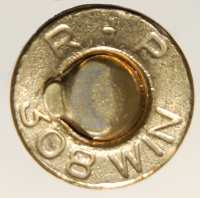
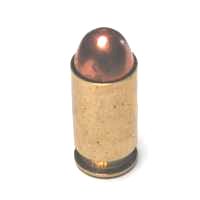
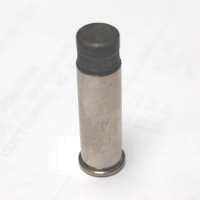
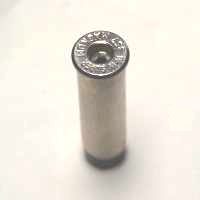
If handloads are carefully made reliability is not an issue, and bad rounds can be culled during inspection. Due to the high speed nature of factory production frequently bad rounds get through. Below are a couple of factory "oops" from my collection. In addition, I've seen bulged cases, split cases, torn cases, upside-down primers, and a case without a flash hole. The moral of the story--check ALL your ammo.
|
|
|
|
|
| Smashed primer | Deep seated bullet | Upside-down bullet | Missing
primer and a metal flap from flash hole |
Buckled case |
|
||||
| Crumpled
neck GI Production |
||||
Q. What are the dates that US military ammunition stopped using corrosive primers?
A. The following information comes from the NRA. While shooting corrosive primed ammunition is not a problem if the firearm is properly cleaned (especially the gas system, if any), corrosively primed cases should not be reloaded. "Safe case date" is date at which all cases with the indicated headstamp can be considered safe for reloading.
| DEN (Denver Ordnance Plant DM (Des Moines Ordnance Plant) EC (Eau Clair Ordnance Plant) U or UT (Utah Ordnance Plant) |
c. WW II -All production in any caliber but .30 Carbine was corrosive |
|
Caliber .30 |
||
|
Headstamp |
Last production | Safe Case Date |
| FA (Frankford Arsenal) | Ball M2 Lot
4149 (10/51) AP M2 Lot 887 (10/51) Match M72 made in 53, 54, and 56 with red, green, or purple sealant around primer. |
FA 52 |
| LC (Lake City) | Ball M2 Lot
13700 (6/51) AP M2 Lot 13158 (4/52) |
LC 52 |
| RA (Remington Arms) | Ball M2 Lot 33853 (11/51) | RA 52 |
| SL (St. Louis Ordnance Plant) | Ball M2 Lot
9420 (5/52) AP M2 Lot 9467 (7/52) |
SL 53 |
| TW (Twin Cities Arsenal) | Ball M2 Lot
19362 (12/50) AP M2 Lot 19776 (2/52) |
TW 53 |
| WCC (Western Cartridge Co.) | Ball M2 Lot 6428 (6/51) | WCC 52 |
| WRA (Winchester Repeating Arms) | Ball M2 Lot
23201 (8/51) AP M2 Lot 22007 (6/54) |
WRA 52 WRA 55 |
| VC (Verdun Arsenal Canada) | All production was non-corrosive | |
| DAQ (Dominion Arsenal Canada) | All production was corrosive | |
| DEN (Denver Ordanance) | All production was corrosive | |
| UT (Utah Ordnance) | All production was corrosive | |
| EW (Eau Claire Ordnance) | All production was corrosive | |
|
7.62 x 51 |
||
|
Headstamp |
Last production | Safe Case Date |
| All 7.62 x 51 mm ammunition is non-corrosive with the exception of a single lot of FA headstamped match ammunition made in 1956 | ||
|
Carbine, Caliber .30 |
||
|
Headstamp |
Last production | Safe Case Date |
|
All .30 carbine ammunition is non-corrosive |
||
|
Caliber .45 ACP |
||
| Headstamp | Last production | Safe Case Date |
| FA (Frankford Arsenal) | M1911 Ball Lot 1542 (7/54) | FA 55 |
| FCC (Federal Cartridge Corp.) | M1911 Ball Lot 1801 (11/53) | FCC 54 |
| RA (Remington Arms) | M1911 Ball Lot 5544 (9/52) | RA 53 |
| TW (Twin Cities Arsenal) | M1911 Ball Lot 180000 (8/53) | TW 54 |
| WCC (Western Cartridge Co.) | M1911 Ball Lot 6375 (11/52) | WCC 53 |
| WRA (Winchester Repeating Arms) | M1911 Ball Lot
22198 (11/51)
Steel cased lots 22000 - 22007 (6/54) |
WRA 52 Brass
Cases
WRA 55 Steel cases |
|
5.56 x 45 mm |
||
| Headstamp | Last production | Safe Case Date |
| All 5.56 x 45 mm ammunition is non-corrosive. | ||
Q. What effect does lubricant in the bore have on bullet impact?
A. Some tests run several years ago by a friend of mine showed that the first shot out of a bore with a light coat oil in it generally printed low and to the right from the normal group position from a clean, dry bore. Using a variety of firearms in .223, .243, 308 Win, and .30-06, errors as much as 9" from the expected impact point at 100 yards occurred.
However, simply wiping the bore out with several tight fitting dry patches to remove any excess oil before firing put all shots were where they were expected to go.
Q. How many spare magazines is enough for my rifle and pistol?
A. As a noted firearms instructor once said, "You can't have too many magazines." At a bare minimum I think you should you should have 4--1 in the gun, 2 reloads, and a spare. I feel comfortable with 9 magazines for combat rifles and 3 for detachable magazine hunting arms, and 6 for pistol, but I confess to having an awful lot of magazines. While we are on the subject, remember to clean and inspect your magazines regularly and to rotate your loaded ready-magazines now and then
Q. How long will the springs in loaded magazines last?
A. A lot depends on the quality of the magazine spring and the number of times the spring is cycled, so there is no pat answer. A metallurgist friend told me that it was "cycling" the spring that wore it out and that a spring, simply compressed and left would take a set but then not weaken any further. In the early 1980s I was given 3 loaded M1911 magazine full of RA18 rounds. The magazines were the old style with the cavalry lanyard loop on their base so they were probably as old as the ammunition. To my amazement all three magazines functioned flawlessly and all 21 rounds of ammo fired. I've had M1 carbine, M16, and M14 magazines that had been left full for years and all worked. On the other hand I have seen cheap after market magazines fail after being loaded for a year. I would rotate (and check) magazines every 6 months to a year just to be on the safe side.
Q. How much of the target does my front sight cover at a given distance?
A. The answer to this is basically the same as calculating sight adjustments.
S = sight radius in inches (The distance from the rear of the front sight to the rear of the rear sight)
W = width of the front sight blade in inches
D = distance to target IN INCHES
T = target coverage in inchesT = (D * W) / S
As an example, if your front sight is .052" wide and the sight radius is 20" and your target is at 25 yards (25 x 36 = 900")
(900 * .052) / 20 = 2.34"
Q. Do you have any suggestions for maintaining my AR type rifle?
A. For bore cleaning I follow normal procedures and use Ed's Red as a bore cleaner. Keep the front sight "up" to prevent cleaner from getting into the gas tube.
Clean the bolt carrier assembly by removing carbon from the bolt cam pin slot, the inside of the bolt carrier (that chrome lined hole where the bolt goes) and the bottom of the bolt carrier itself. You can use a wet pipe cleaner or a worn bore brush to clean the inside of the bolt carrier key. Do not put anything inside of the gas tube- it is unnecessary, and you will only stick debris in there that will cause problems
Attach the chamber brush to your cleaning rod and scrub out the chamber. I generally use a worn brush with a wet patch wrapped around it and insert it in the chamber. Spin it a few times and replace it with a new brush. Spin that and then dry the chamber out. Clean out the locking lugs in the barrel extension with cotton swabs. Clean out the upper receiver and charging handle.
Use a toothbrush to clean the bolt, especially the bolt lugs.
As for lubrication it has been proven that the AR system runs much better wet then dry, even in dusty climates. The preferred oils for the AR platform are Slip EWL or Milcomm MC2500 (TW25B oil). For grease (on the hammer and sear points or larger bearing areas like the inside of the upper receiver and charging handle) use Slip EWG or Milcomm TW25B. For just the sear point and hammer notch you can use a little bit of moly automotive grease.
Consider that your rifle is an internal combustion engine. Like an internal combustion engine, it requires lubrication to make it function. However, just don't put lube on, but put it on in the right places. There are certain wear points in the gun that need attention, and failure to do so can cause a stoppage. A good rule of thumb is to look for shiny marks, which indicate metal to metal contact. If it shines, lubricate it.
Remove the bolt from the bolt carrier. Turn the bolt carrier over and observe the shiny area on the bottom. This is a wear point. The slot that the bolt cam pin rides in is another wear point, as is the chromed hole in the bolt carrier that the bolt rides in. The entire bolt carrier should have a coat of lube, but pay particular attention to any shinny areas. The military also states that a drop of lube down the bolt carrier gas key is required. The bolt itself requires a coating of oil, paying particular attention to the bolt rings and the lugs. Keep in mind that when firing many rounds a day, the bolt will get blown dry. Putting a couple of drops in the 2 holes of the bolt carrier during a break in the action will lube the bolt rings and will keep the gun running.
Before reassembling, check the locking lugs on the bolt and the extractor for chips or cracks, and check the area around the cam pinhole for cracks. Check your bolt rings for serviceability as follows. Insert the bolt fully into the bolt carrier. Suspend the assembly (preferably over something soft) by holding just the bolt head. If the carrier falls of the bolt of its own weight the rings are starting to wear and will need replacement shortly. Repeat the test but hold the assembly by the rear of the carrier. If the bolt drops out on its own, you need to change the gas rings immediately. If it passes these tests, you are good to go. You don't have to bet paranoid about misaligning the gas rings. Colt Armorer Instructors state emphatically that the gun will run with one good ring, but misalign the slots anyway--why take a chance.
Lastly, inspect your magazines for damaged or cracked feed lips and disassemble the magazines and clean the interior. Leave the magazine insides dry. For best reliability your 30 rd magazines should have the gray or tan Gen III anti-tilt followers although the green followers are useable. You can click here for my "Living with the AR Platform" web page which goes into this subject more fully.
Q. How can I determine the freshness of batteries I buy for my red dot sights and flashlights?
A. When I purchase Alkaline batteries (cells, actually) I always try not to buy product that may have been sitting on some store shelf, stockroom or warehouse for who knows how long. It is not at all uncommon for me to note that, occasionally even in outlets that would seem likely to have rapid turnover of new stock, to see date codes on batteries that are OVER A YEAR OLD. When purchasing batteries in bulk I have noticed that batteries at places like COSTCO have a high turnover rate and are probably fairly fresh. However, they don't carry the more esoteric batteries like the CR2032, 123 and 1/3N sizes used on most red dot sights. In that case you have inspect things or rely on the honesty of the mail order supplier. I have had excellent service from Medic batteries (www.medicbatteries.com) in this regard as they guarantee the freshness of their batteries.
To the best of my knowledge, only Duracell marks their individual battery packs with a date code that is easily deciphered.
If you look on the back of any blister-pack of Duracell batteries you will see an 8 or 9 digit alphanumeric code stamped on the back of the pack along the side or bottom. As an example on the back-side of the pack of AA batteries along the bottom is stamped something like 10A18CP22.
Only the first 4 or 5 characters matter to you because this is the actual date of manufacture. The last several characters are the factory location and the assembly line code. In the example above (10A18CP22) the first (or 1st and 2nd) number is the year. The letter following the 1st (or 2nd number) is the month ie; A=Jan, B=Feb, C=Mar, D=Apr, etc.
The numbers following the month letter are the day of the month. The example given (10A18CP22) is read as 2010 Jan 18.
While we are talking about batteries note that all battery manufacturers do not recommend storing batteries in the refrigerator or freezer. Store at room temperature in low or moderate humidity, in a manner that does note let the electrodes of the battery touch and that keeps them from rattling around. Also do not store in an air tight container as there is some out-gassing.
Thanks to Mike Baker for the info on the Duracell date stamps.
Q. How can I test my batteries?
A. The question always comes up about how to test batteries. There are commercial battery test unit you can buy but remember they have to test batteries under load. The two top units seem to be the ZTS MINIMBT (about $45 from Amazon) and the ZTS MBT-1 - Multi-Battery Tester (about $90 from Amazon) which test the batteries under pulsed load. The MINIMBT will test 1.5v alkaline (AA, AAA, C, D, N), 1.2v NiMH/NiCd, 3v photo lithium, and 9v alkaline. The MBT-1 tests all those plus lithium, button, and coin cell batteries and some exotics.
You can test your batteries under static load yourself with a multi-meter and some resistive loads. Using the resistance stated below if the measured voltage is lower that the battery spec the battery is weak.
|
Battery Type |
Resistive Load |
AAA, AA |
150 ohms |
C, D |
60 ohms |
123 |
65 ohms |
9V |
900 ohms |
1/3N |
300 ohms |
CR2032 |
15,000 ohms |
Button (357, D76, SR44) |
6,500 ohms |
While some of those resistances are not common you can mix series and parallel resistors to get the right value. The formula for parallel resistors is
Rtotal = 1/(1/R1+1/R2+1/R3 ...)
and there are online calculators available.
Q. How do I determine how much to move or file my fixed sights to get a zero?
A. For fixed sights the the only way to zero is to either physically move the rear sight for deflection or alter the height of either the front or rear sight for elevation. The formula to determine the amount of adjustment is:
M = S * D / (R * 12)
Where:
M = amount of movement or change in sight height needed (in inches)
D = distance in inches need to move the bullet's strike to hit point of aim
R = range to target in FEET
S = distance between the front edge of the rear sight and the rear edge of the front sight blade (in inches)
Note that to move a bullets strike horizontally move the rear sight in the direction you need to go. To adjust elevation either lower the front sight or raise the rear sight to raise the bullets impact, or raise the front sight or lower the rear sight to lower the bullet's impact. As an example if your sight radius is 5" and you need to move the bullet's strike 3" higher at 25 yd (75 feet):
M = 5 * 3 / (75 *12) = .016
thus you need to lower the front sight (or raise the rear sight) by .016 inches.
Q. How much ammunition for my firearms do I "need?"
A. Again, this is one of those questions that fights start over. There's the old saying, "One can't have too much ammunition." However, the answer depends on what you are preparing for. If you are just talking about hunting once or twice a year the answer might be a box or two. For a possible survival scenario the answer might be several thousand rounds. Keep in mind that in hard times that ammunition is worth a lot on the barter market, so even if you don't own anything in some calibers you might want to stock a couple of boxes of calibers common to your area like .32 ACP, .380 ACP, 9 mm, .38/.357, .40 S&W, .270 Win, .30-30, etc.
While your needs may differ, my usual recommendation for a basic working stock is: 22RF - 2-5,000 rd; centerfire pistol - 500-1,000; centerfire rifle - 500-1000; shotgun - 500; "homeland defense rifles" - 1-2,000. These quantities are basically "case" quantities. Note that these totals don't include practice ammo/reloads.
A friend of mine stores all his ammo in "ammo can" quantities, using either the standard GI ".50 cal" can (5.25" deep x 11" wide x 7.25" high.), or the "fat 50" can (which are about 6 3/4" deep x 12" wide x 8 1/2" high). Whatever fits is a basic stock. The hard to find double 50 cans (5.25" deep x 11" wide x 13.25" high) also work well. These ammo cans have the advantage of being water and air tight, and easily stackable.
Q. How can I prepare firearms and ammunition for long term storage?
A. One of the best rust preventive preparation around is the Lee Liquid Alox bullet lubricant. This is actually the same material used by the Ziebart Co. to rustproof automobiles, and is a mixture of 45% calcium soap and 45% mineral spirits (petroleum distillates).
According to Alox Corp., who sold the product under the stock no. 606-55, this material was intended to be sprayed on naval machinery on the decks of ships to protect against salt spray. It is very much like the cosmolene grease used on weapons during WWII, except that it does not have to be heated to be applied, and it can be readily thinned by dilution with mineral spirits, or heated in a double-boiler (taking proper precautions against fire).
It has been successfully used on weapons which have been exposed to complete salt water immersion, and it did a better job protecting them than anything else. The only drawback is that it dries hard and is somewhat difficult to remove, but the material does come off readily with military rifle bore cleaner (Mil-C-372B or Mil-L-63460), or by use of steam cleaning, a vapor degreaser or scrubbing with ordinary firearms cleaners. It must be removed from the bore prior to firing, as would any grease or wax, because it would constitute a bore obstruction.
If you wanted to bury a gun in a container for several years, and have it ready for future use, I would clean and lubricate it well with a conventional cleaner and then coat all exposed metal surfaces with Lee Liquid Alox. If you need to be able to fire the weapon soon after taking out of the container, do not put the Alox in the bore. Your normal cleaner will protect the bore.
I would then wrap the weapon up in polyethylene plastic, containing about 100g of silica gel packets, and place the whole thing in a hard gun case, preferably made of fiberglass or ABS plastic with rubber gaskets, wrap this in a tarpaulin, and bury it on a slope with good drainage, where it is protected by overhanging rocks or trees.
Another option that has recently come to light that makes long term storage really easy are the vacuum pack storage bags used by the military and now available at Brownells. The interior of these heavy duty aluminized bags is treated with a Vapor Phase Corrosion Inhibitor that will not harm optics or stock finishes. To use you clean and lube the weapon normally place it in the bag and seal, and then using a common vacuum cleaner suck out all the air through the bags one-way valve, and then place in a secure storage container. They are rated for storage up to 20 years and come in 3 sizes: a 11"x 15" handgun size (Brownells #080000822), a 14" x 49" tactical rifle size that will accommodate rifles with optics attached (Brownells # 080000824), and a 11 " x 54" for longer rifles and shotguns (Brownells # 080000823).
Batteries should be packed in a non-conducting container that prevents terminal contact and then sealed in a bag. (Do not vacuum pack them.) Loose ammunition should be sealed in bags and then placed in military style steel ammunition cans along with a desiccant package. Boxed ammunition should be packed in GI ammo cans with a desiccant. Thoroughly coat the can with Alox 606-55, then wrap in plastic and bury. All the seams of the plastic wrappings should be sealed with tape. If you use fresh batteries and ammunition of good quality and and they are protected from extreme temperature changes the batteries can last 5 or more years and ammo at least 40 years.
Speaking of desiccants, you can make a very good home made desiccant by cutting pieces of plaster board to fit inside your storage container, dry them in a 250 degree oven for about 2 hours, cool, wrap lightly (don't seal) in aluminum foil, and place in your container before sealing.
The Alox company is now part of the Lubrizol corporation located at.
The Lubrizol Corporation
29400 Lakeland Boulevard
Wickliffe, Ohio 44092
USA
440-943-4200
Alox 606 does not seem to appear in their current product listing so there may have been a name change. They do list several "rust preventatives" such as Alox 2100, 2153, and 2188. Contact them directly for further details. It is supposedly available in smaller quantities from http://www.lsstuff.com/lube/liquid-x.html or http://dragonbulletlube.com/products.php
Two other commercial products that are available in many hardware stores and that get very high marks from many folks are the aerosol Boeshield - T9 (www.boeshield.com) and Corrosion-X (www.corrosionx.com) which is available in aerosol or liquid.
Q. What are the various primer types and sizes?
A. The currently available Boxer primer sizes and types are listed below.
|
Brand |
SP(soft) |
SP |
SPMag |
LP |
LPMag |
SR |
SRMag |
SR (hard) |
LR |
LRMag |
LR (hard) |
|
CCI |
- |
500 |
550 |
300 |
350 |
400, BR4 |
450 |
41, M41 |
200, BR2 |
250 |
34, M34 |
|
Federal |
100, 100M |
- |
200, 200M |
150, 150M |
155, 155M |
205, 205M |
N/A |
205MAR |
210, 210M |
215, 215M |
- |
|
Remington |
- |
1 ½ |
5 ½ |
2 ½ |
- |
6 ½ (low pressure) |
7 ½ BR |
- |
9 ½ |
9 ½ M |
- |
|
Winchester |
- |
WSP |
WSPM |
WLP |
- |
WSR |
- |
41 |
WLR |
WRLM |
- |
|
Wolf |
- |
NSCP |
NCSPM |
NSLP |
NCLPM |
NCSR |
NCSRM |
223 |
NCLR |
NCLRM |
- |
NOTES:
CCI M41 and M34, Federal 205MAR, and Wolf 223 are designated “hard” military primers and contain “magnum” primer mix and should be treated as such
Federal 100 SP is designed for use in PPC revolvers with lightened hammer springs. Do not use in high pressure loadings. (15kpsi max)
Federal “M”, Rem 71/2 BR and CCI "BR" primers are “match” primers The Rem is slightly hotter but not a real magnum primer
Berdan primers (click here for how a Berdan primer differs from Boxer primers) on the other hand are available in such varying dimension as to seem like there are no standards. There is an excellent discussion of Berdan primers and sizes at http://www.dave-cushman.net/shot/berdan_supplies_dimensions.html
Q. Do you have any plans for or parts sources for reasonably priced gun racks?
A. A source for very nicely made, ready to assemble, unfinished racks of various kinds as well a pre-cut parts to assemble them yourself can be obtained from Mosin Racks at 7.62x54r.net/MosinID/MosinRacks.htm. Tell Ted I sent you.
Q. How do you remove the handguards on an AR rifle?
A. While it can be done (with great effort) by hand it generally requires 2 people with the physique of the Incredible Hulk to depress the "delta ring" enough to remove the handguards.. There are commercial tools that you can get that make it easy, but they run about $25. Some years ago instructions were posted on the web on how to make a handguard removal tool for just a couple of dollars and minimal effort using 1/4" steel rod and a MAPP or propane torch.. The instructions are difficult to locate these days so I contacted the author, Doug Paul, and have received permission to make his instructions available on my site. Click here to download a 560k MS Word version of the instructions.
Please email comments to Fr. Frog by clicking here.
| Back to Q&A Index | Ballistics Main Page |
| Back to Fr. Frog's Home Page |
Disclaimer
As far as I know all the information presented above is correct and I have attempted to ensure that it is. However, I am not responsible for any errors, omissions, or damages resulting from the use or misuse of this information, nor for you doing something stupid with it. (Don't you hate these disclaimers? So do I, but there are people out there who refuse to be responsible for their own actions and who will sue anybody to make a buck.)

Updated 2023-03-09 @16000