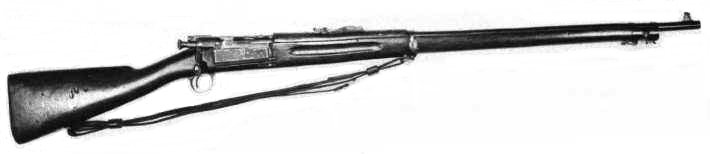
| M1896 Krag Rifle |
 |
This page is provided for those aficionados of Theodore Roosevelt who are interested in the arms issued to and used by US forces and the Rough Riders during the Spanish American War. While it is not a complete history, this page will provide a good basic reference on the Krag rifles and their ammunition.
Missing or unknown data is marked as "n/a." If you can supply any of the missing data please email me by clicking here.
| The Rifle | The Ammunition | Ballistics |
The Krag Jorgensen rifle was originally designed by Captain Ole Hermann Johannes Krag, who was the director of the Royal Norwegian Arms Factory at Kongsberg (Kongsberg Våpenfabrikk), and Erik Jørgensen, also of Kongsberg, Norway.
This rifle was chosen by a US military board which convened to find a new service rifle to replace the .45-70 Springfield single-shot rifles then in service. The board first met in New York in December of 1890 and concluded their proceedings in July of 1892. They compared rifle designs from Lee, Krag, Mannlicher, Mauser, Schmidt-Ruben, and about 40 other military and civilian designs. The trials were held at Governors Island, NY.
While it was adopted in 1892 as the military rifle of US forces, it was not produced until 1894. Because the adoption of a foreign design upset some of the American inventors of competing rifles, the government was pressured to conducted a second round of tests during April and May of 1893. None of the other rifles passed the testing and the Krag was then put into production. According to government records 442,883 Krag rifles and 63,116 carbines (these figures vary slightly depending on the source) were eventually manufactured by Springfield Armory with a $1.00 royalty for each rifle going to the two inventors. The Krag, was also adopted as the service rifle of Norway as the M1894 in 6.5 x 55 mm, and in 8 x 58 mm R (rimmed) by Denmark as the M1898.
The Krag was the first US rifle to have the top of its barrel covered with wood for a handguard. While it is known for having the smoothest action of any rifle, its one locking lug action was not as strong as some of the other designs which utilized 2 or 3 lugs and made it susceptible to group stringing with wet ammunition because of unequal bolt face force. Its side mounted magazine was claimed to be slow to load but the slowness of reloading was not viewed as a shortfall. At the time, the US military philosophy still placed great emphasis on precise aimed fire and looked upon the magazine as a reserve. (While high volumes of fire are now all the rage, and while they serve to allow mobility of force, it is interesting to note that, even in this day and age, when the military needs results it is the precision rifleman armed with a bolt action rifle that is called upon to do the job.)
The ballistics of the .30-40 cartridge were not equal to those of other available modern military rounds including the 7 x 57 mm Mauser used by Spanish forces. It should, however, be noted here that the 7 mm Mauser was used only by the elite Spanish regular forces. The local troops and militia units were armed mainly with Remington Rolling Block single shot rifles in 11.15 x58R (.43 Spanish black powder) which fired a 387 gr lead bullet at about 1340 fps and which was inferior to even the US .45-70 round, or the 11.5 x 75R smokeless which fired a 395 gr pointed thinly jacketed bullet at about 1280 f/s, and which was known for creating very nasty wounds due to jacket separation.
The Krag, "U.S Magazine Rifle, Model 1892," or as it was often referred to, "The .30 Caliber Springfield Rifle of the Krag-Jorgensen Pattern" was made in several different models and variation during its 11 year service life. All models were fitted with 4-groove .308" diameter barrels which had a 1:10 " twist. I have been unable to find any accuracy standards but the rifle was deemed to be "effective" at 600 yards against infantry and 650 yards against cavalry, which would lend itself to saying about 2 moa.
As an interesting aside, in spite of its "slow to reload" magazine, War Department records indicate that it was possible for a skilled shooter to fire 43 aimed shots in 2 minutes using the rifle as a magazine fed repeater and 42 shots in the same time as a single loader. These times were recently confirmed by a correspondent from Norway who informed me that in a national match the 3rd place winner got 27 hits at 100 and 200 meters in 50 seconds using a Krag rifle.
Despite all of its shortcomings the Krag rifle served faithfully in the Spanish-American War (1898), the Philippine Insurrection (1898 - 1904), the battle of Tagalii, Samoa (1899), and the China Relief Expedition--also known as the Boxer Rebellion (1900). It also was issued for guard duty service during both WW I and WW II.
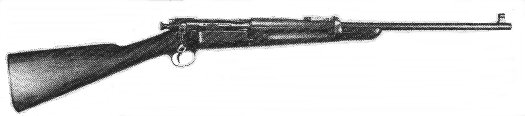
The Krag rifles utilized by US Forces during the Spanish American War were the M1892 and M1896 models. While many of the Rough Riders carried their own arms, their government issued rifle was the Krag M1896 carbine since they were considered to be cavalry (dismounted).
Below is an An interesting article published upon the introduction of the Krag-Jorgensen in 1894, in "The American Engineer and Railroad Journal", Nov. 1894. vol. 68, no. 11, p. 491
"New Army Rifles — The new army rifle which has been adopted to take the place of the Spring field rifle is 80 in. [sic] long in the barrel, with a horizontal magazine lengthwise with the barrel. This magazine contains five cartridges, and has a cutoff, so that the piece can be used as a single-shot arm and the rapid fire of the magazine held in reserve, while the firing of single shots goes on at the rate of 30 per minute. The entire arm weighs about 8 Ibs., including a knife shaped bayonet. The bayonet is quite as great a departure from the old- style weapon as is the arm. The familiar three-cornered piece of steel belonging to the infantry military arms of all nations for 150 years has given way to the knife-blade form of bayonet.
"But the interest in the new arm culminates in the cartridge it fires. This weighs about one -half as much as the old 45-70-405 Springfield cartridge. As the new arm is much lighter than the old, the soldier can carry 175 or even 200 rounds of the new ammunition without any increase of load beyond what the old cartridge gave when but 100 were carried. The charge of powder for the United States rifle is now 37 grains of a German smokeless explosive known as the Wetteren. Something very like it will be adopted for permanent use. This was chosen because it gave but little smoke, if any. Its burning produces a mist-like vapor, and the report is about one-half as loud its that of the service charge of black gunpowder. The bullet is about an inch long, of hardened lead, with a very thin covering of nickel or steel. In order to ensure to so long and slender a missile steadiness of flight over such enormous ranges, a more rapid twist in the rifle became necessary. The barrels of the new rifle have four grooves about .003 in. deep. They have one turn in about 12 in., or two and a half complete twists in 30 in.
"A long and slender bullet fired with the extreme velocity of 2,000 ft. per second would not take the rifling in arms with so short a twist at all, but would " strip" or jump the grooving and leave the gun nothing but a shapeless slug of lead. In order to overcome this, the hard metal coating of the bullet was necessary, as well as the increased hardening of the lead used in the projectile. The writer in the Army and Navy Journal who gives the above information regarding this rifle, says, that there are two interesting questions that are yet to be settled. The first is, whether the bullet, with all its power, possesses the stunning effect, the " knocking-out" force, that is necessary to disable an antagonist at once. In battles with the Arabs in the Soudan the English found that they required a blow from a bullet that would knock them down. The small-bore projectile has but a small striking surface.
"The only test on live human beings that have been made were very recently in some small skirmishes between British infantry, armed with the new rifle, and the hill tribes along the Burmese border. In these combats the small bullets did not prove so effective as the old-time .45-caliber 480-grain missile of the Martini-Henry. Men were hit two and three times, but not immediately knocked down and prevented from fighting. A savage, be he a Zulu, an East Indian hillman, or an American Indian, must be at once disabled to prevent his doing further harm. An interesting illustration of this once came under the writer's notice.
"In May, 1859, part of the Second United States Regiment of Cavalry (Troops A, B, C, F, G and H) fought a very sharp action with 1,500 Comanche warriors. Lieutenant Hood (afterward lieutenant-general in the Confederate Army), the adjutant of the command, went into the fight armed with a heavy ten-bore double gun loaded with a heavy charge of buckshot. He shot an Indian with both barrels at a distance of not more than 15 paces. Though terribly wounded, the savage had still power enough to shoot and wound Hood very severely with an arrow, to pin Major Thomas' chin down to his breast with another and to mortally wound an enlisted man with a third arrow before he himself died. The average white man would have been crippled beyond possible exertion by the shock of such wounds as the Indian received, but the red man still had the use of his arms, and handled his bow and heavy steel-pointed war arrows with almost deadly effect until the breath had actually gone out of him. The immediate use of this new weapon in the United Stales will be in the occasional Indian outbreaks that may occur from time to time."
| M1896 Krag Rifle |
|
| M1896 Krag Carbine |
 |
| Krag Rifle Variations | |||||
| Model | Barrel (in) |
Weight (lb) |
OAL | Adoption Date |
Miscellaneous |
| M1892 Rifle | 30 | 9.38 | 49 | 1892-09-15 | Mag cut-off operates in
up position. Identifiable by cleaning rod under barrel. |
| M1892 Carbine | 22 | 8.3 | 41.2 | -- | Prototype--only one known. Looks like a short standard rifle. |
| M1896 Rifle | 30 | 8.94 | 49 | 1896-02-19 | Mag cut-off operates in
down position, cleaning rod moved to butt trap, improved
rear sight, tighter manufacturing tolerances increased accuracy, thicker grip area of stock for strength. |
| M1896 Cadet Rifle | 30 | 9.0 | 49 | 1895-06-01 | Fitted with cleaning rod
like M1892 rifle. Only about 400 were made before it was discontinued. |
| M1896 Carbine | 22 | 7.75 | 41.2 | 1896-05-17 | Same modifications as M1896 rifle |
| M1898 Rifle | 30 | 9.0 | 49.1 | 1898-03-14 | Wide variety of minor improvements |
| M1898 Carbine | 22 | 7.80 | 41.2 | 1898-03-14 | Same modifications as M1898 rifle |
| M1899 Carbine | 22 | 7.87 | 41.2 | n/a | Slightly longer forearm and handguard. No swivel ring. |
| M1899 Constabulary Carbine | 22 | 8.03 | 41.2 | 1906-02-10 | Basically a carbine
fitted with a full length stock and a bayonet lug. Muzzle is stepped down to accept bayonet. Built for Philippine police use. |
The ammunition for the Krag is known under numerous names.
| .30-40 US Krag .30-40 Krag, US Army .30-40 Krag Army .30-40 Krag .30-40 Krag & Winchester .30 USA .30 M1892 .30 M1896 .30 M1898 |
.30 Flanged .30 US Krag .30 USA Army .30 USA .30 Krag .30 Army 7.62 (Kal .30) US Krag Jorgensen M/93 |
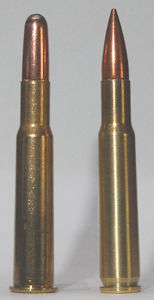
It is most commonly referenced as .30 US Army. A rimless version of the .30-40 cartridge was tested, but not adopted due to extraction issues that would have required a new extractor design. If the rimless version had been chosen instead, the Krag rifle would have been faster to load since there would have been no worry about rim overlap in the magazine. Due to the one lug design of the Krag rifle, pressure was limited to 38 - 40,000 cup. Given a stronger action and a 45,000 cup pressure limit, ballistics equal to period .303 British or current .300 Savage, would have been obtainable -- 220 gr at 22-2300 fs. Originally designed as a "balloon head" case it was changed to the stronger solid head case in 1895.
The basic ammunition load for the Krag armed soldier was 100 rounds carried in a double-loop "Mills" belt about the waist but many soldiers carried a second belt over the shoulder.
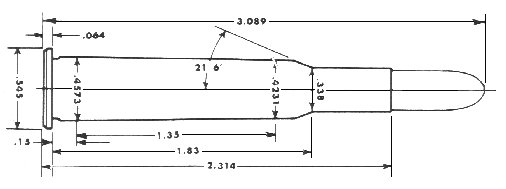
| .30-40 US Army Cartridge Basic Specifications | |
| Weight of loaded ball round | 435 to 442 gr |
| Cartridge case | Brass or tinned brass |
| Bullet Jacket | Cupro-nickel or steel. Several different designs used. |
| Bullet Core | Lead and tin (mix not stated) |
| Bullet Length | 1.26" |
| Bullet Diameter | .308" |
| Bullet Weight | 220 gr (From 1890 to 1893
a 230gr bullet was issued. No ballistic data is known.) The jacket was made in both steel
jacketed and cupro-nickel jacketed. |
| Powder Charge | 35 to 42 gr of
nitrocellulose powder, 38 gr normally listed. The ammunition was also loaded with Cordite powder by the English firm of Kynoch and these headstamps carry the letter "C" |
| Muzzle Velocity (Ball) | 1,960 ± 15 fs (rifle) @ 53' from the muzzle. This equates to a muzzle velocity of 2000. In the carbine the muzzle velocity was 1920 ± 15 fs. Pressure was 38 - 40,000 cup. In October of 1899, the round was loaded to 2200 fps (rifle) at 45,000 cup in an attempt to improve ballistics, but reports of cracked locking lugs began to surface. In March of 1900 the remaining stocks of this ammunition (3.5 Million rounds) was returned to the arsenals, broken down, and reloaded back to 2000 fps. |
| Penetration (Dry Oak @ 3’) |
45" - 48" |
| Ballistic Coefficient | One source from APG gives the value of .270. The bullet had a rounded tip with a very little taper from the major diameter. Modern 220 gr bullets seem to run about G1 = .310 - .312. The original firing tables were based on the Ingals drag model (GI) with a BC of around .3 |
I have not found any definitive accuracy standards but several source mentioned 1.5 - 2.0 MOA from the rifle, and if I really concentrate I can get 2 MOA from an 1896 carbine so that seems in the ball park. The tiny thin front blade coupled with a very tiny and narrow rear notch makes accurate shooting hard for folks with mature eyes..
| .30-40 Krag Cartridge Dimensions (SAAMI) |
 |
| .30-40 US Army Cartridge Issued Variations | ||
| Cartridge | Identification | Miscellaneous Information |
| Ball | Long round nosed bullet | 38 to 42 gr of Peyton, DuPont, or Laflin & Rand powder. Brass or tinned case |
| M1893 Blank | Case extended to look like a bullet. Small hole and 3 slots in tip | Charge was 65 gr of black powder |
| M1896 (M2) Blank | Natural color paper bullet | Case contains 5 gr EC powder and bullet contains 5 gr EC powder |
| M3 Blank | Cannelure around case neck and shellacked paper wad | Possible a commercial
variant. Seen with late 1920-1930s date stamps. |
| M1896 Gallery Practice | No visible bullet. Case neck is cannelured about half way down | One 00 ball of about 50 grains. Originally the bottom half of the cartridge case was solid with a long flash hole using 5 gr of black pwder. This was changed to a standard case design using is 5.2 gr of unnamed smokeless powder (probably similar to Bulseye). |
| Short Range Load | RN 180 gr lead bullet | Loaded to approximately 900 -1200 fs. Frequently seen with a blackened case |
| Garrison Gallery Load | Short semi-pointed lead bullet | Bullet variations exist as this was hand loaded by different units |
| M1902 Multi-Ball Riot Load |
Cannelure at base of cartridge neck | 2 round lead balls |
| M1895 Dummy | Fluted, drilled, or fluted and drilled case | Many variations some locally made. Base of neck usually had a cannelure to prevent bullet set back. |
| Sub-Caliber Artillery Trainer | Large protected primer | May be found with both
the 220 grain round nose bullet, a 173 gr pointed bullet (.30 M1 boat tailed bullet), or a lead 107 gr bullet |
| M1904 Guard | 156 gr or 177 gr RN lead bullet | Crimp around case neck. V=1,150 |
| Barrel Proof Cartridge | Several variations known | Used to proof barrel blanks and not fired in rifles. Frequently they used a separately loaded bullet which were referred to as "high presure blank" with slug. Loaded to 60,000 psi. No firearm proof cartridge is known |
| Military was
normally RA, F, or FA with date. However, ammunition was
produced for government use by Kynoch in England and
headstamped K or KC with the date and by Winchester with
a WRA headstamp. Commercial production is usually marked
".30 USA," ".30 Government," "or
.30 Army."
Military primers were corrosive. |
||
The firing table below shows the approximate ballistics for the .30-40 Krag ball round fired from the Krag rifle with a 30" barrel and the 7 x 57 mm ball round fired from the 30" barreled M93/M95 Mauser. This data is based upon modern bullets of the same design and weight. A 300 yard zero is used and the sight height of 1" is assumed. (The actual sight height of the Krags ran from .85" to the .975" depending on the particular model.) "Standard" atmospheric conditions are assumed. The data presented for the .30-40 compares well with the original firing tables so the 7 x 57 data should be close too.
As can be seen, the 7mm with its substantially flatter trajectory has a ballistic advantage over the .30-40 Krag. The 7 mm's other advantage was that the rifle was capable of a much higher sustained rate of fire in semi-trained hands than the Krag due to its stripper clip loading ability, and its truly smokeless ammunition made the shooter more difficult to spot compared to the Krag and especially to the .45-70 black powder Springfield single shot rifles.
As an interesting aside, despite rumors to the contrary and the fact that it shot flatter, the 7 mm was not all that effective as the following quote from Theodore Roosevelt's book The Rough Riders shows.
The fight was now on in good earnest, and the Spaniards on the hills were engaged in heavy volley firing. The Mauser bullets drove in sheets through the trees and the tall jungle grass, making a peculiar whirring or rustling sound; some of the bullets seemed to pop in the air, so that we thought they were explosive; and, indeed, many of those which were coated with brass did explode, in the sense that the brass coat was ripped off, making a thin plate of hard metal with a jagged edge, which inflicted a ghastly wound. These bullets were shot from a .45-calibre rifle [actually the 11.5 x 57R Spanish Reformado] carrying smokeless powder, which was much used by the guerillas and irregular Spanish troops.
The [7 mm] Mauser bullets themselves made a small clean hole, with the result that the wound healed in a most astonishing manner. One or two of our men who were shot in the head had the skull blown open, but elsewhere the wounds from the minute steel-coated bullet, with its very high velocity, were certainly nothing like as serious as those made by the old large-calibre, low-power rifle. If a man was shot through the heart, spine, or brain he was, of course, killed instantly; but very few of the wounded died even under the appalling conditions which prevailed , owing to the lack of attendance and supplies in the field-hospitals with the army.
The Rough Riders, by Theodore Roosevelt, Charles Scribner's Sons, New York, 1903, page 121-122
Surprisingly little early experimentation seems to have been done with lighter or pointed .30 caliber bullets that I can find any reference to. (One experiment round using a 131 gr pointed boat tail bullet was done in 1909 and gave a velocity of 2890 f/s, but nothing came of it as the .30-03 and .30-06 cartridges were then under development.) Using the powders of the day it would have been possible to reach about 2550 f/s in the rifle with a 150 gr spitzer bullet or about 2400 f/s with a 173 gr spitzer or boat tail, at safe working pressures. With a 173 gr bullet the .30-40 would have matched the ballistics of the 7mm and with a 150 gr or so would have substantially bettered them. Interestingly, in 1893 there were some experiments done using .22 caliber bullets of between 112 gr and 120 gr on modified .30-40 cases and velocities of about 2600 f/s were achieved. However, the powders of the day were not really suitable and based upon the results the project was dropped.
 |
|
What the .30-40 could have
been. 220 gr Ball 1898 (L) and rimless prototype with |
In October of 1899 a large batch of ammunition for the Krags was loaded to a muzzle velocity of 2200 f/s at 45,000 psi in an attempt to boost the round's ballistics. However, reports started coming in from the field of cracked locking lugs and bullets stripping in the rifling and this ammunition was recalled, broken down, and reloaded to standard specifications.
Those reloading for the Krag (including the 6.5 x 55 mm Norwegian and 8 x 58 mm R Danish) should keep pressures to 40,000 psi and under.
| Comparative Ballistics (Based on modern bullets) |
|||||||
| .30-40 US Army Cartridge* (220 gr FMJ-RN - G1 BC=.312) |
7 x 57 mm Spanish Cartridge (175 gr FMJ-RN - G1 BC=.285) |
||||||
| Range (yd) |
Velocity (fps) |
Energy (ft lb) |
Trajectory (in) |
Velocity (fps) |
Energy (ft lb) |
Trajectory (in) |
|
| 0 | 2000 | 1954 | -0.85 | 2300 | 2055 | -0.85 | |
| 100 | 1764 | 1520 | 11.8 | 2019 | 1504 | 8.9 | |
| 200 | 1549 | 1173 | 13.2 | 1760 | 1204 | 10.1 | |
| 300 | 1361 | 906 | ± | 1527 | 906 | ± | |
| 400 | 1207 | 712 | -32.0 | 1326 | 684 | -25.1 | |
| 500 | 1092 | 583 | -87.8 | 1168 | 530 | -70.0 | |
| 600 | 1011 | 500 | -172 | 1057 | 434 | -140 | |
| 700 | 950 | 442 | -291 | 979 | 373 | -241 | |
| 800 | 901 | 397 | -449 | 921 | 329 | -379 | |
| 900 | 859 | 360 | -649 | 872 | 295 | -558 | |
| 1000 | 821 | 329 | -1069 | 829 | 267 | -728 | |
| * This is a very close match to the original US Government firing tables. | |||||||
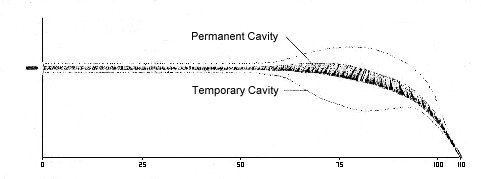
The wound profile below is typical of the wound produced by long, round nosed, non-expanding bullets with the bullet ending up base first. Due to the bullet shape and moderate velocity the permanent cavity is not very spectacular, although it does penetrate very well. The permanent cavity is slit shaped where the bullet tumbles, but note that this effect does not start until about 60 cm of penetration has occurred--well outside of a typical human torso even on a 90 degree hit.) The 7 x 57 mm with its 175 gr round nose bullet would give a very similar wound profile contrary to period rumors of its effectiveness.
.30-40 Krag Loading Data
Dies
.30-40 Krag dies are available from most reloading manufactures. I have found the
LEE die set along with a factory crimp die to be excellent
.30-40 Standard Loads
While there are several modern powders suitable for the .30-40 Krag most of
then give rather low load density which results in erratic velocities. Of
all the powders I have tried, the best powder for the .30-40 appears to be
IMR 4350 which gives excellent load densities and
velocities. Modern pointed bullets generally do not give good performance
in original .30-40 chambers because they were designed with a long throat to accommodate
the long round-nose projectiles of the day. With my current lot of powder
a 220 gr Hornady RNSP on top of 40.5 gr of IMR4350, with Winchester primers duplicates the original
loading nicely.
|
Suggested Krag Loading Data |
|||
| 180 gr RN | 200 gr RN | 220 gr RN | |
| Powder | Charge Range (gr) | Charge Range (gr) | Charge Range (gr) |
| IMR 4350 | 42 - 45 | 41 - 44 | 40 - 44 |
The M1904 Guard cartridge can be duplicated with a 150 or 170 gr cast round nose bullet such as the Lyman 311466 or 311407, and 18 - 19 gr of 2400
The short range training load can be duplicated with a 180 gr RN cast bullet and about 8 gr of Unique.
.30-40 Krag Blank Ammunition
.30-40 blanks for reenactment or ceremonial purposes are easy to make.
Use 6 - 10 gr of Red Dot and work up to get the sound you want. Make a case mouth wad by cutting plugs of
1/8" - 1/4" foam using a sharpened .30 Carbine case, and seat about
3/32" into the case mouth in.
Seal with a drop of glue. You can roll crimp the case mouth or use a
rosette crimp die. These generally won't feed from a rifle without a
feedway modification.
If you want to purchase commercially made .30-40 blanks Atlantic Wall Blanks carries them. http://www.atlanticwallblanks.com/3040-KRAG-FULL-LENGTH-BLANK_p_22.html at a very reasonable price for a bag of 90.
Another solution is to run .303 British long nose military blanks through a .30-40 Krag sizing die -- minus the decapping stem. Lubricate the cases before sizing.. You can also use a file type trim die in a press for the same thing, sizing dies are more common. Sportsman's Guide lists them https://www.sportsmansguide.com/product/index/ppu-303-british-extended-blank-ammo-15-rounds?a=1581643
Reference Material
The Rifle in America, by Philip B. Sharpe, William Morrow & Company, New York, 1938. (Out of print. Was reissued in a special collectors addition by the National Rifle Association in 1995.)
The Krag Rifle, by William S. Brophy, Gun Room Press, 1985, ISBN: 0882270257 (Out of print)
The Reliable Krag, by Ludwig Olson, Rifle Magazine, March-April, 1992, p. 20
The Krag Rifle Story, by Franklin B. Mallory with
Ludwig E. Olson, Springfield Research Service, Silver Springs, MD, 1979, ISBN:
0960330607 (Out of print but available from
http://gunshowbooks.com/cgi-bin/webc.exe/st_prod.html?p_prodid=GS199529)
History of Modern U.S. Military Small Arms Ammunition, Vol. I: 1880-1939, by F.W. Hackley, W.H. Woodin, & E.L. Scranton, Macmillan Co., New York, 1967
Rifle Caliber Blank Cartridges, by Charles H. Yust, Jr., The American Rifleman, February, 1966, p. 42
Cartridge Corner--Krags And The Spanish American War, by Stu Miller, Shooting Times, November, 1962, p. 38
Ammunition-Its History, Development and Use, by Melvin Johnson & Charles Haven, William Morrow & Company, New York, 1943, p. 88
Krag Jorgensen .30-40 Takedown Guide, by Radocy , Publisher Radocy Take Down Guides
Description and Rules for the Management of the .30-40 Krag Krag M1892 Rifle and Carbine, and Description And Rules For The Management Of The U.S. Magazine Rifle and Carbine, Caliber .30, by US Government Printing Office. Republished by Firing Pin Enterprises, Phoenix, AZ
No. 1920, Description and Rules for the Management of the U.S Magazine Rifle, Model of 1898 and Magazine Carbine, Model of 1899, Caliber .30, Government Printing Office, PDF copy of original manual.
A good source of Krag information is available at http://www.kragcollectorsassociation.org
Thanks to Dan Lowery for this source.
If you know of any other good reference books or magazine articles on either the US Krag rifle or its ammunition, or if you can supply additional information, please email me by clicking here with the particulars.
Please email comments to Fr. Frog by clicking here.
| Back to the Rough Riders Page | Back to the Theodore Roosevelt Page | Back to Fr. Frog's Home Page |

Updated 2019-03-22